How to Clean an Air Fryer (After Every Use and Monthly Deep Clean)
How to clean an air fryer without wrecking it: a two minute after-use routine, a monthly deep clean for the heating element, and what to never use on it.
Reader-supported. EggBoo may earn a commission when you buy through links on our site. It never costs you more, and it never decides our picks.
Nobody buys an air fryer dreaming about the washing up. But the machine that makes dinner crispy is also the machine flinging hot fat around a small metal box, and if that fat never leaves, it comes back as smoke, a stale smell in your fries, and a nonstick coating that gives up early. The good news: cleaning an air fryer properly takes about two minutes after most meals, plus roughly twenty minutes once a month.
This guide covers the two routines that matter, the after-every-use wipe-down and the monthly deep clean, then the awkward extras: baked-on grease, the heating element nobody thinks to touch, lingering smells, and the cleaners that will quietly destroy your basket. Your manual is always the final say, but the job is the same across Ninja, Cosori, Instant, and the rest.
How often to clean what
| Part | How often | What it needs |
|---|---|---|
| Basket and crisper plate | After every use | Warm soapy water, soft sponge, dried fully |
| Drip pan or drawer bottom | After every use, or after anything greasy | Wipe or wash out pooled fat before it hardens |
| Interior walls | Every few cooks, or when you see splatter | Damp cloth with a little dish soap, then dry |
| Heating element | Monthly, sooner if it smokes | Soft brush and a barely damp cloth, never running water |
| Exterior and vents | Monthly | Wrung-out damp cloth, soft brush on the vents |
| Whole-unit deep clean | Monthly, or every 20 to 30 cooks | All of the above in one go, about 20 minutes |
If you cook bacon, wings, or sausages regularly, treat that as the minimum. Fatty foods are the reason most air fryers end up grim, and the reason most air fryers start smoking: grease baked onto the element eventually burns on contact. Cleaning is not just tidiness, it is the fix for a problem you would otherwise be googling with the smoke alarm going.
What you actually need
Almost nothing, which is the point. Warm water, dish soap, and a non-abrasive sponge handle most of it. A few cheap extras make the fiddly parts easier, and none are mandatory.
| Tool | What it is for | Skip it if |
|---|---|---|
| Non-scratch sponge | The daily basket wash without scoring the coating | You already own soft sponges |
| Soft-bristle brush | Crisper plate holes, corners, vents, the element | You clean weekly and nothing is caked on |
| Baking soda | Paste for baked-on stains, and killing odors | Nothing in your fryer has ever burnt on |
| Microfiber cloths | Wiping the interior and exterior without lint | Paper towels are fine by you |
- Non-scratch sponges. The Yolk: the cheapest way to make a nonstick basket last longer, because the green scouring pad under your sink is what kills coatings. Pros: costs pennies, no learning curve. Cons: it will not shift genuinely burnt-on carbon on its own, which is what the baking soda is for. Check current price on Amazon (as of August 2026).
- A soft-bristle cleaning brush. The Yolk: reaches the crisper plate perforations and the intake vents where a sponge cannot. Cosori's own care guidance calls for a soft-bristle brush around the heating element and the bottom vents, so this is the manufacturer's tool, not an upsell. Cons: cheap ones shed bristles, so pick a firm-handled dish brush over a flimsy bottle brush. Check current price on Amazon (as of August 2026).
- Plain baking soda. The Yolk: the only "special" cleaner an air fryer needs, and you probably own it already. Pros: food-safe, non-abrasive as a paste, works on fresh and baked-on grease, doubles as an odor absorber. Cons: it needs dwell time. Check current price on Amazon (as of August 2026).
Skip if: you were about to buy a branded "air fryer cleaner" spray. None do anything warm soapy water plus baking soda does not, and some are harsh enough to be a bad idea near nonstick.
The two minute clean after every use
Ninja's own support guidance is blunt about frequency: the fryer, basket, and crisper plate should be cleaned after every use, and the unit unplugged first. That sounds like a lot until you do it, at which point it is shorter than loading a dishwasher.
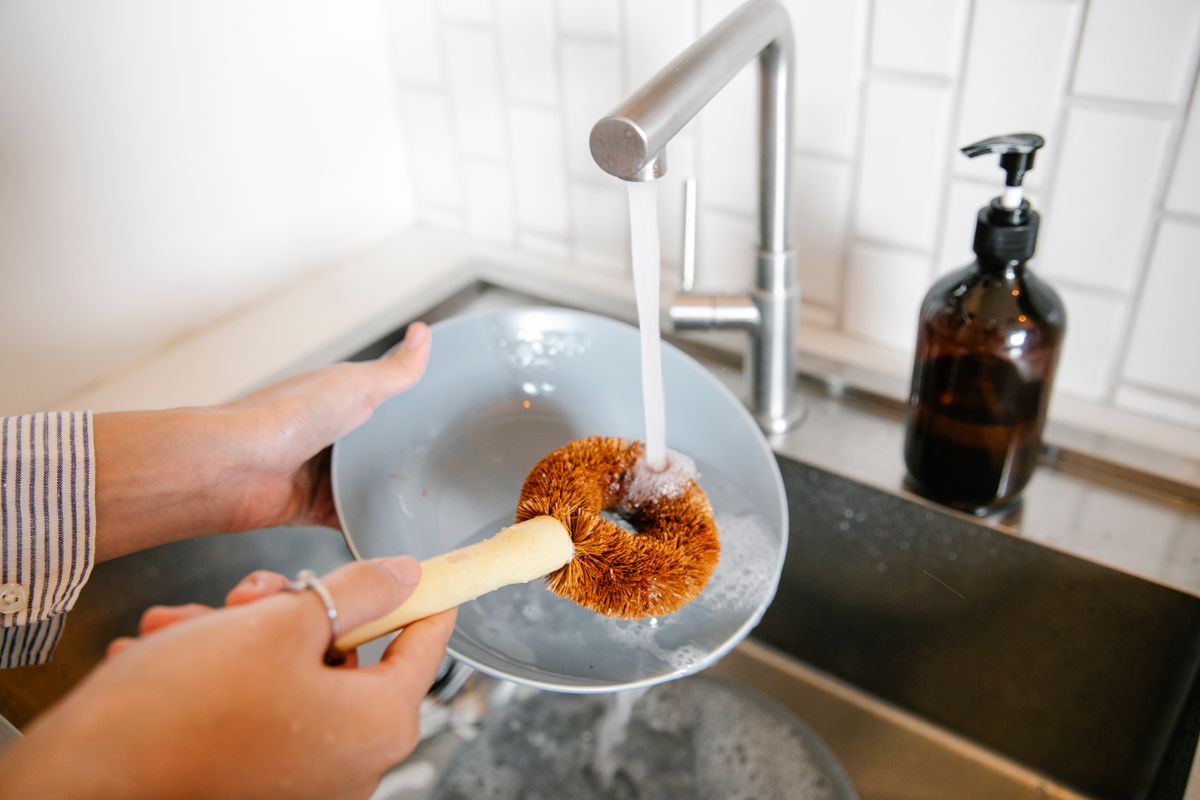
1. Unplug it and let it cool. Ten to fifteen minutes is enough. Do not run cold water into a hot basket, thermal shock is unkind to coatings and to your hands. 2. Tip out the crumbs and pour off the grease. Not down the drain, though. Let it set and bin it, or wipe it out with a paper towel. 3. Wash the basket and crisper plate in warm soapy water. Use a non-abrasive sponge, and lift the crisper plate out of the basket, because the gap between the two is exactly where grease hides and hardens. 4. Wipe the inside of the drawer. A wrung-out cloth with a little diluted dish soap is all this needs. Never fill the main unit with water or put it near a tap. 5. Dry everything completely before it goes back in. Trapped moisture is how you get a musty smell and, over time, rust spots on exposed metal.
That is it. If nothing greasy happened, a wipe and a rinse is enough and you are done in ninety seconds.
The monthly deep clean, step by step
Once a month, or every twenty to thirty cooks, give it the full treatment. Budget twenty minutes, most of which is unattended soaking time.
1. Unplug, cool, disassemble. Pull out every removable part your model has: basket, crisper plate, racks, skewers, drip tray. Check your manual, because oven-style and dual-basket models have more pieces than a single-drawer fryer.
2. Soak the removable parts. Fill the sink with hot water and mild dish soap and let the basket and crisper plate sit about fifteen minutes. Cosori's care guidance recommends exactly this before scrubbing, and Ninja says the same for stuck-on residue. Soaking does the work so your sponge does not have to, which is the whole trick to protecting the coating.
3. Scrub gently, then rinse and dry. Soft sponge on the flat surfaces, soft-bristle brush through the crisper plate holes and into the corners. Rinse thoroughly, because leftover soap film bakes into a smell next time you cook.
4. Do the interior walls. Cloth dampened with diluted dish soap over the chamber walls and the inside of the drawer, then dried. Splatter that looks permanent usually is not, it just needs the baking soda treatment below.
5. Clean the heating element. The step almost everyone skips, and the one that stops smoke. With the unit unplugged and cool, tip the fryer on its back or reach up into the chamber so you can see the coil. Sweep it with a soft-bristle brush to lift dust and loose carbon, then wipe with a barely damp cloth. Instant's guidance for the Vortex is explicit that the element gets a damp cloth and is never submerged, and Cosori warns against applying water to it directly at all. Wring your cloth out until it feels almost dry.
6. Wipe the exterior and clear the vents. A wrung-out damp cloth on the shell, a dry cloth on the control panel so you are not pushing moisture into buttons, and a soft brush over the intake and exhaust vents. Blocked vents make the fan work harder and the fryer run hotter than it should.
7. Reassemble only when everything is bone dry. Then plug it back in.
Rescuing baked-on grease and burnt residue
If your basket already has dark, sticky patches that laugh at a sponge, do not reach for anything stronger. Reach for baking soda.
Make a paste of baking soda and a little warm water until it is thick and spreadable. Cosori's published stain instructions use roughly two tablespoons of baking soda to one tablespoon of water. Spread it over the stained areas, leave it about fifteen minutes, then scrub gently with a soft sponge and rinse thoroughly. Stubborn spots want a second pass rather than more force. More force is how coatings die.
For the chamber walls and around the element, put the paste on a cloth sparingly rather than slathering it on, and keep it away from electrical connections. You want a damp film that softens grease, not a puddle.
If a whole basket is carbonized, soak it in hot soapy water overnight before the baking soda pass. Patience is the best tool in this job.
Getting the smell out
Air fryers hold onto fish, garlic, and anything sweet and sticky. If the machine is properly clean and the smell is still there, the standard fix is acid and a short run.
Put a small oven-safe ramekin of white vinegar, or a mix of lemon juice, vinegar, and water, into the basket. Run the fryer at a high temperature for two to three minutes, switch it off, and leave the drawer closed for around half an hour so the vapor can work on the interior. Wipe it out afterwards and leave the drawer open to air.
A dish of dry baking soda left in the closed basket overnight handles mild staleness. Neither trick replaces cleaning. If the smell survives both, the residue is usually still on the element, so go back to step five.
Should you just put the basket in the dishwasher?
Mostly yes, with one honest caveat.
Ninja, Cosori, and Instant all state that the basket, crisper plate, and accessories are dishwasher safe, and Instant suggests the top rack to keep parts away from the heat below. Older units and some budget models are hand-wash only, so check your manual once rather than guessing.
The caveat is longevity. Cosori's own maintenance guidance says hand washing is typically recommended to preserve the nonstick coating, even on parts labeled dishwasher safe. That is the manufacturer being cautious, not us. Dishwasher detergents are strongly alkaline and the jets are aggressive, and peeling coatings are a frequently reported complaint among owners who run baskets through a cycle constantly.
Our read: use the dishwasher when a basket is genuinely grim and you cannot face it, hand wash the rest of the time. Two minutes at the sink is cheaper than a replacement basket.
The main unit never goes in the dishwasher, and it never goes in the sink. It holds the fan, the element, and the electronics. Damp cloth only, always.
What never to touch it with
This list is short and it is the whole difference between a fryer that lasts and one that does not.
- Steel wool, scouring pads, and metal scrapers. They scratch nonstick coatings, and once the surface is broken, food sticks, cleaning gets harder, and the coating starts flaking away.
- Oven cleaner, bleach, and ammonia. Far too harsh for a coated basket, and they leave residues you would rather not eat. Air fryers do not get oven treatment.
- Abrasive powders and heavy-duty degreasers. Same problem, gentler packaging.
- Submerging the main unit or spraying it. Electrical components live in there. No sink, no dishwasher, no hose.
- Aerosol cooking spray. Not a cleaner, but worth repeating: the propellants and lecithin in aerosol cans gum onto nonstick surfaces and build a sticky film that resists cleaning. A refillable oil mister avoids it, one of several habits in our guide to common air fryer mistakes beginners make.
- Metal utensils in the basket. Tongs and forks scrape the coating while you cook. Silicone or wood.
The one habit that halves the work
Line it, sometimes. Perforated parchment or silicone liners catch drips from anything saucy, sugary, or fatty, so the mess lands on the liner rather than baked onto your basket. There are rules about airflow and preheating, which our guide to using parchment paper in an air fryer walks through. But for wings, glazed salmon, or anything with barbecue sauce on it, a liner turns a scrubbing job into a binning job.
The other half of the habit is washing the basket before the grease cools and sets. Fresh grease wipes. Cold grease scrubs. Baked grease smokes.
FAQ
How often should I clean my air fryer?
Wash the basket and crisper plate after every use, which is what Ninja's own support guidance recommends, and wipe the drawer whenever anything greasy happened. Do a full deep clean including the element, interior, and vents about once a month, or every twenty to thirty cooks if you use it daily.
Can I put my air fryer basket in the dishwasher?
Usually yes. Ninja, Cosori, and Instant all list the basket, crisper plate, and accessories as dishwasher safe, and the top rack is the safer spot. Check your manual first, because some older and budget units are hand-wash only. Cosori still recommends hand washing where you can, to preserve the nonstick coating.
How do I clean the heating element in my air fryer?
Unplug the unit and let it cool completely, then tip it back or reach into the chamber so you can see the coil. Sweep it with a soft-bristle brush, then wipe with a barely damp cloth. Never pour or spray water onto the element. If grease is baked on, use a little baking soda paste on the cloth rather than liquid, clear of any electrical connections.
What is the best thing to clean a really greasy air fryer basket with?
Hot water, mild dish soap, and time. Soak the basket fifteen minutes or longer, then scrub gently with a non-abrasive sponge. For stains that survive, spread baking soda paste over them, leave it about fifteen minutes, scrub gently, and rinse. Avoid steel wool, oven cleaner, and bleach entirely.
Why does my air fryer still smell after cleaning?
Usually because residue is still on the heating element or chamber walls, not in the basket you just washed. Deep clean the interior and element first. If a faint smell remains, run the fryer two to three minutes with a ramekin of white vinegar inside, leave the drawer shut about half an hour, then wipe it out and air it.
Can I use vinegar to clean my air fryer?
Yes, diluted and sensibly. A one-to-one white vinegar and water solution on a cloth is fine for wiping the interior and cutting grease, and a short vinegar run is the standard odor fix. Do not pour vinegar into the unit, do not make undiluted vinegar on nonstick a habit, and keep liquid away from the element and vents.
Does cleaning my air fryer stop it from smoking?
Very often, yes. If your fryer smokes even with lean or lightly oiled food, the usual cause is old grease burning off the heating element. A monthly element clean plus washing the basket after each use removes the fuel. Our full breakdown of why air fryers smoke covers the other causes.
Can I use soap on the inside of my air fryer?
Yes, diluted and on a cloth, never poured in. Cosori's care guidance describes wiping the interior walls with a cloth dampened in diluted soap, then drying thoroughly. The moisture stays in the cloth and never runs freely inside the machine. Go over it again with a plain water cloth so no soap film bakes in.
If cleaning is the reason you hate your air fryer
Some machines are simply harder to clean. Fixed crisper plates, deep narrow drawers, and parts that are not dishwasher safe all add friction to a chore you do constantly. If that is where you are, the answer might be a different machine rather than a better sponge.
Our air fryer finder lets you filter by what matters to you, and our guide to choosing an air fryer covers the design details that decide whether cleanup takes two minutes or ten, including removable crisper plates, dishwasher-safe parts, and drawer shape.
EggBoo Verdict: Wash the basket and plate after every cook while the grease is still soft, deep clean the interior and element monthly with soap, a soft brush, and baking soda paste, and keep steel wool and oven cleaner nowhere near it. Your air fryer stops smoking, stops smelling, and keeps its coating for years. Good return on two minutes a day.